
The Feeling of Understanding
AI, learning and judging what we have understood
An AI explanation can make a difficult subject feel surprisingly straightforward. The answer arrives in orderly steps, the language is clear, and something that seemed confusing a few minutes earlier now makes sense.
But how reliably can we judge what we have understood?
On 29 October, The Times reported an interesting difference in how people perceive AI's effects. In a Public First survey of 2,000 adults, 59% agreed to some extent that AI was making people less intelligent. Yet respondents were generally more positive about its effects on their own abilities, including brainstorming and writing.
Professor Cecilia Heyes of the University of Oxford suggested that one possible explanation is processing fluency. When information is easy to follow, we may experience a feeling of understanding that exceeds what we have actually grasped.
The survey tells us about peoples' perceptions, rather than changes in their intelligence or learning. Heyes's explanation raises a further question: whether feeling that we understand something is a reliable guide to what we have actually learnt.
A 2025 study published in the Proceedings of the National Academy of Sciences speaks more directly to that question.
Researchers worked with nearly 1,000 secondary-school students in Turkey, comparing their mathematics performance with and without AI assistance.
Students using a relatively unrestricted AI tutor performed 48% better during practice than those without AI. Yet on a subsequent unaided test, they performed 17% worse than students who had practised without AI.
A second AI tutor, designed to provide guidance rather than simply supply answers, produced a much larger improvement during practice: 127%. But this group showed no statistically significant improvement over the control group on the unaided test.
The researchers also examined students' perceptions of their own learning.
Students using the unrestricted tutor did not recognise that their subsequent performance had been worse. Those using the guided tutor believed they had performed better, although their test results did not show a corresponding improvement.
The study did not investigate processing fluency as an explanation for these findings. It was also limited to short-term mathematics learning in one school. Nevertheless, the results suggest that students' own impressions of progress may not reliably reflect what they have learnt.
A separate study, published in Computers in Human Behavior in 2026, asked adults to answer logical reasoning questions with AI assistance and then estimate their own scores.
Their average performance was about three points higher than that of a previously collected reference sample without AI, but they overestimated their own scores by approximately four points. Because the comparison came from an earlier dataset, the difference in performance cannot be attributed solely to AI.
Misjudging our own understanding did not begin with AI. It is a familiar part of human learning, although AI may change how we experience it.
In our first CognateUK Practice Note, What can we see when students are working?, we reflected on a CognateHelix taster session and asked how much of students' reasoning educators could observe. The research discussed here raises a related question: how accurately can learners recognise the extent and limits of their own understanding?
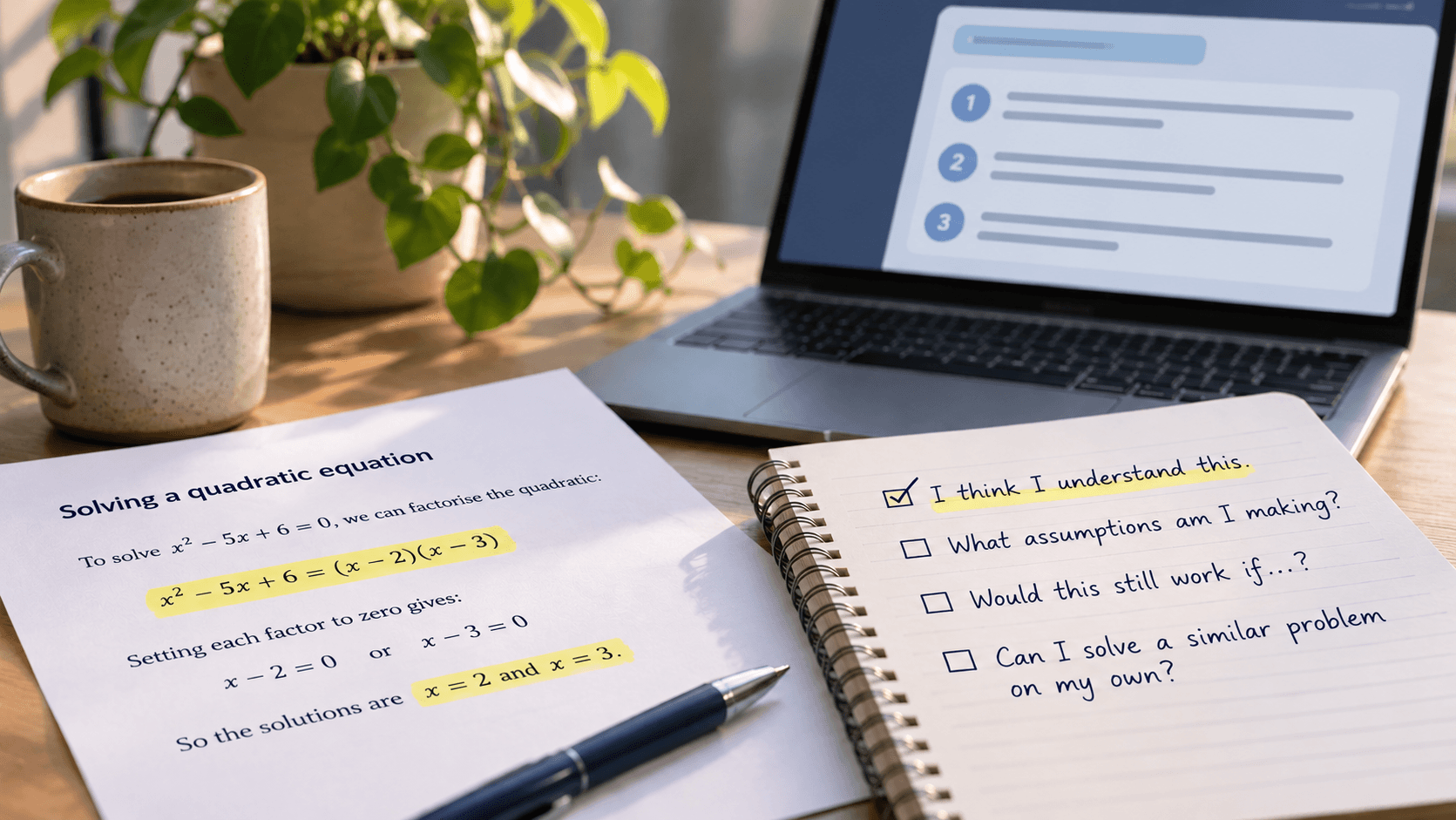
An explanation may seem convincing, but can we recognise which parts we understand securely? Can we identify an assumption we have accepted without questioning it? When the problem changes, can we recognise where our understanding no longer helps?
These are different from asking whether the original answer was correct.
They also suggest something worth investigating in learning design. What happens when students have opportunities to test their understanding after receiving an explanation, encounter an unfamiliar variation, or discover that an assumption they accepted was incomplete?
Such activities may help reveal gaps in understanding. Whether they also help learners become better at recognising those gaps independently, and whether that development lasts, requires further evidence.
AI can make unfamiliar material more accessible and allow people to attempt work they could not previously manage. Those possibilities matter.
When AI makes something feel understood, how does a learner know what they have actually learnt?
Sources
- Oisín Cahalane, “AI users think it makes them smarter — and others more stupid”, The Times, 29 October 2026.
- Hamsa Bastani et al., “Generative AI without guardrails can harm learning: Evidence from high school mathematics”, Proceedings of the National Academy of Sciences, 2025.
- Daniela Fernandes et al., “AI makes you smarter but none the wiser: The disconnect between performance and metacognition”, Computers in Human Behavior, 2026.