
What can we see when students are working?
CognateUK Practice Note 01: observations from a CognateHelix taster session
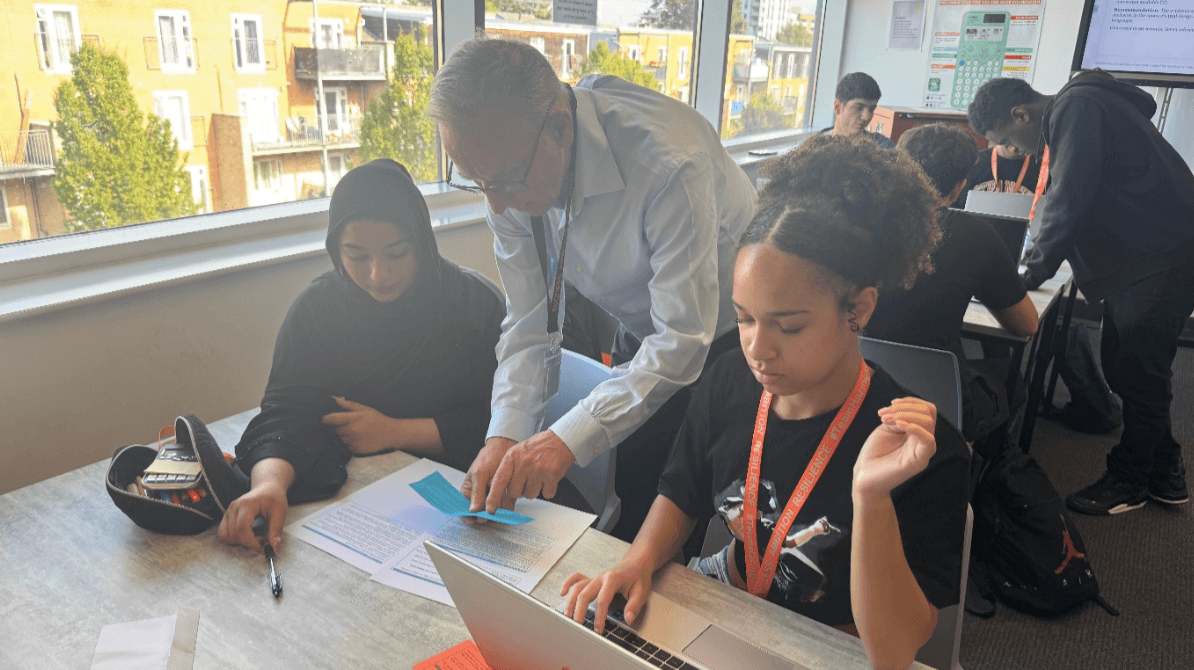
Year 12 students working through the evidence-checking task during the CognateHelix taster at Haringey Sixth Form College.
On 23 September, around 20 Year 12 Maths students at Haringey Sixth Form College were given a decision to make during a 40-minute CognateHelix taster session.
In a fictional life-sciences company, their team had an AI-generated evidence summary, supported by seven references, which was intended for a sponsor.
Working in groups, the students had to decide whether it should be sent.
Every group decided that it should not.
At first, that looked like the clearest result of the exercise. Looking back, it was not the most informative part.
Groups found that some references could not be traced at all. The harder part of the task was built around references that did exist. One paper, for example, studied sustained vowel sounds rather than natural conversation and drew its 263 recordings from 43 people, yet the summary described the evidence as large scale.
Finding a paper was not enough. The task asked students to judge what it had studied and whether it answered the question in front of them.
One of the lessons offered back from the room at the end was simpler: check the source.
It is a useful starting point. But several groups reached their decision before they had time to gather all of the evidence behind it. The closing discussion was also shorter than planned, partly because of how we had set up the session.
We heard what each group had decided, but very little about why.
What could we see?
This was one 40-minute session. It was not designed as research, and we should not treat it as evidence of a general pattern.
These are also our observations as the people who designed and led the session.
Students and teachers may have seen things differently.
What the session did leave us with was a question.
When a student gives an answer or makes a decision, how much can we see of the thinking underneath it?
A group can reach the expected decision without us hearing how individual students arrived there. And a task can reveal one part of a student’s thinking while leaving another part largely hidden.
In this case, groups questioned the evidence summary and found that some references could not be traced. We saw much less of how students judged whether a genuine source was relevant, sufficient or being represented fairly.
What we will try next
In a future version of the activity, we want to protect more of the closing discussion so that students have time to explain why they reached their decision, rather than leaving us with the decision alone.
We also need to make the opening of the task easier to enter, rather than introducing unfamiliar roles and the problem itself at the same time.
These are practical changes, not conclusions about what works.
They may help us see more of students’ reasoning. Whether they also give students better conditions in which to develop that reasoning is a different question, and one that will take longer to answer. We will return to it as the programme develops.