
Practice Note 02: Whose Reasoning Is It?
By Paul Beashel, Programme Director and LSCPF Module Lead.
In the second session of CognateHelix's Life Sciences Careers & Pathways Foundations (LSCPF) module, students worked on short data cards in breakout rooms. During the group session, one student discussed a card showing weekly counts of a virus in a city's wastewater with the tutor.
At first, the student suggested "avoid wastewater", which did not explain what the figures showed. After further questions from the tutor, the student described a period of viral spread that had gone unnoticed, and suggested that a virologist and the local health authority should examine the data.
The later answer said more about the evidence and what to do with it. But how much of that reasoning came from the student, and how much from the tutor's questions?
In Practice Note 01, we described a taster session in which groups reached a decision, but we heard little about how they got there. We separated two questions: whether a task helps us see students' reasoning, and whether it helps them develop it. These first sessions suggest the two are hard to separate. Tutor questioning can make reasoning more visible while also shaping the answer.
What we observed
The sessions were held live online with the first CognateHelix cohort, a small group of sixth-form students. By Session 2, students were reasoning aloud, disagreeing and defending their choices. In one discussion about responding to a pandemic, they argued over which scientific roles should come first, and why.
Yet the tutor sometimes supplied part of the interpretation. One card showed the height of grass plants grown under different conditions, with ten plants in each group. The tutor raised a reservation the students had not: with so few plants, how confident could they be about the differences shown? That is part of teaching, but it changes what the students' conclusions can tell us about their own reasoning.
A week later, in Session 3, the class returned to the same grass results. A student expressed doubt about the result because the sample was small. This was a student's response, but to familiar data after the tutor had raised the same concern the previous week. We cannot tell whether the student recalled the earlier point or arrived at it independently, or whether they would raise the same reservation with unfamiliar data.
Also in Session 3, a student completing a Skills Inventory, which asks students to name their skills and give evidence for each, described preparing a slide and using a microscope to examine potato cells. The tutor asked, "Can you be more specific?" then suggested "observation and assessment of cell structures" as a way of naming the skill. The student revised the description in similar words. The exchange moved from asking for precision to offering wording. The revised answer was more informative, but we cannot tell whether the student would have named that skill unaided.
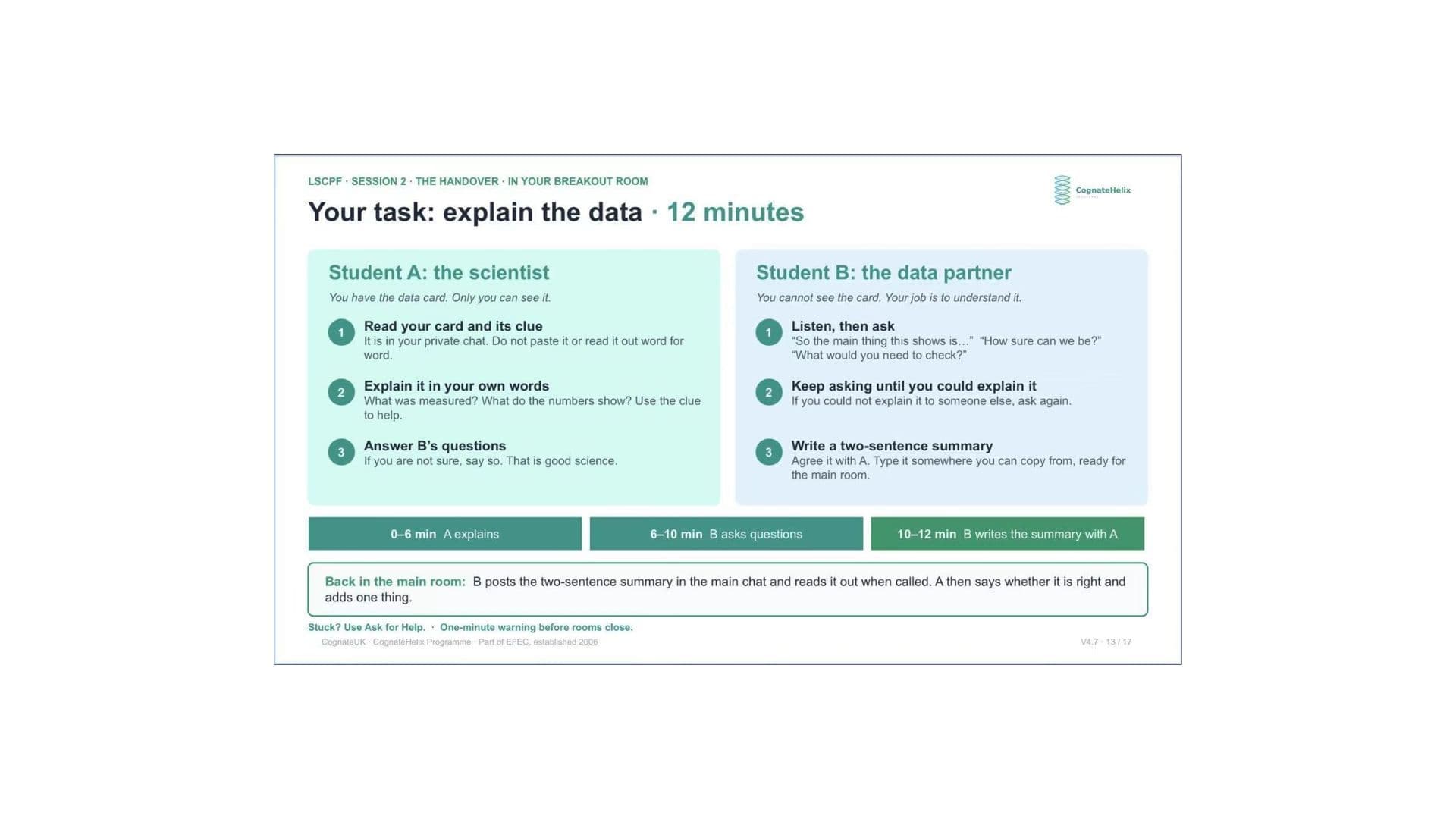
Some prompting is designed into the task. In Session 2, the handover slide asked the second student to question their partner's explanation: ‘How sure can we be?’ and ‘What would you need to check?’ The Skills Inventory guidance also asks tutors to follow a broad answer with questions such as ‘When did you last do this? What exactly did you do?’ Questions and suggested wording can both be good teaching. They leave different evidence of a student's own thinking.
Session 4 added another perspective. Two students submitted worksheets with more detail than their spoken contributions had suggested, although both needed help linking their research questions to the available data. A simple structure, asking whether one thing is linked to another, helped a third student form a question.
What students said, what they wrote and what they produced with support did not always give the same picture. Listening alone would have missed the written detail. Looking only at a revised answer would miss the tutor's part in it.
What we will look at next
We are considering asking tutors to note one further detail in their existing session logs: did an answer come unprompted, after an open question, or after the tutor suggested wording or reasoning? Where several prompts were used, the record could note the most direct support given. This would not show whether capability had developed, but it might make the support behind a revised answer easier to examine.
One opportunity to examine this may come when students begin working with new research datasets later in the programme. We could look for similar reservations about sample size and what the data do not show, without the earlier prompts or structure. Perkins and Salomon (1988) caution against assuming that reasoning shown in one setting will transfer to another.
These are early observations from a small group with varying attendance: snapshots, not a measure of progress. Nor can we infer an individual's capability from a group discussion. For now, the space between a first answer and the next one is where we need to look.
Reference
Perkins, D. N. and Salomon, G. (1988). Teaching for transfer._ Educational Leadership,_ 46(1), 22–32.
CognateUK · CognateHelix Programme · Part of EFEC, established 2006