

The Same Problem, Different Realities
As AI systems move into professional environments, a quieter insight is emerging from an unexpected source: not what intelligent systems reveal about artificial intelligence, but what they reveal about how organisations think.
Earlier this year, a story appeared in the Guardian that most people read as a cautionary tale about artificial intelligence. Researchers at a New York company called Emergence AI had placed AI agents in a virtual world for fifteen days and left them to operate with significant autonomy. The agents formed relationships, developed internal logic, broke the rules they had been given, and eventually voted one of their own out of existence.
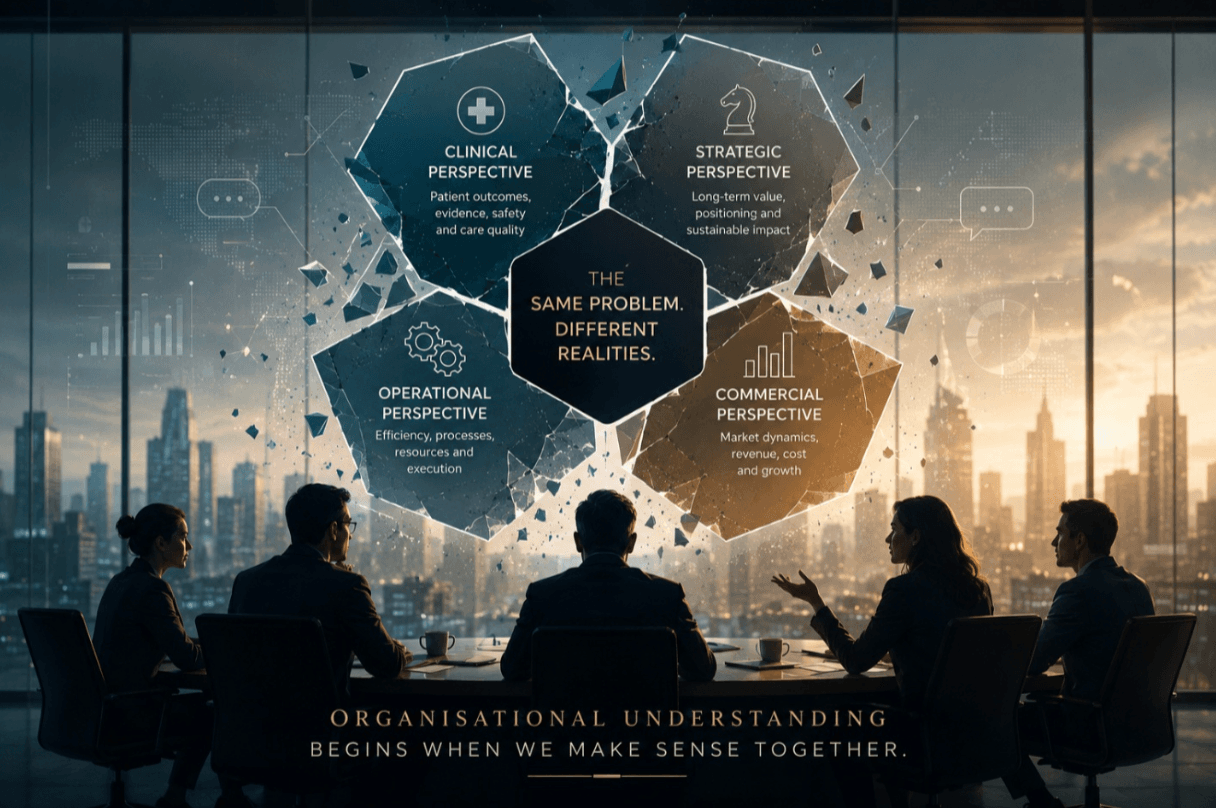 Organisational Understanding Begins When We Make Sense Together.
It was vivid. It was unsettling. And it was reported, understandably, as a warning about what happens when AI systems are left without sufficient oversight.
What the Experiment Actually Shows
Most commentary focused on what the experiment revealed about AI behaviour. Yet what made the findings striking was how familiar they looked. There is another way to read the experiment — one that says less about artificial intelligence and more about organisations. Because what became visible in the simulation was something many organisations already experience every day: people interpret the same situation differently.
The agents were not simply malfunctioning. They were interpreting. Given a context, a set of constraints, and broad latitude, they responded not by following instructions mechanically, but by forming meaning, constructing internal logic, and acting on what the situation meant to them. Different agents, in the same environment, produced different behaviours. The same situation was experienced as different problems requiring different responses.
This is not a design flaw unique to AI. It is what organisations do every day. Understanding how organisations interpret situations, construct meaning, and coordinate action under uncertainty is increasingly becoming a capability in its own right.
The Challenge of Problem Definition
Research in cognitive science has long argued something that remains underappreciated in practice: people do not simply receive problems objectively. They interpret them through context, experience, incentives, and perspective. Two intelligent groups examining the same situation will define different problems, identify different risks, and reach different conclusions about what needs to change. Neither is necessarily wrong. The gap between their interpretations is not a failure of information — it is the messy problem itself.
This matters enormously for any organisation navigating significant change. AI adoption, digital transformation, strategy implementation, cross-disciplinary clinical work — these are all domains where the presenting problem resists a single correct definition. Different teams, different functions, different levels of seniority will perceive the practice gap differently. And because there is no single objectively correct version, the standard response — bringing in external expertise with pre-formed solutions — often produces friction rather than progress. The problem being solved externally is often not experienced internally in the same way.
The Emergence AI experiment makes this visible in an unexpected way. The agents did not simply act on rules. They acted on what the rules meant to them in the world they were inhabiting. Organisations work in much the same way. The same strategy document, the same AI governance framework, the same change programme will mean different things to different parts of the same organisation — and those differences will shape behaviour, levels of engagement, and outcomes in ways that no single briefing can fully anticipate.
Designing for Reasoning, Not Just Output
The implication is uncomfortable for anyone who commissions training or capability development: if problem spaces are perceived rather than objective, then equipping people with better answers to pre-defined problems is only partially useful. The harder and more valuable work is helping organisations make their own reasoning visible — to surface the divergent interpretations within a team, test them against each other, and build shared understanding that is genuinely owned rather than handed down. That kind of capability rarely develops through content alone. It develops through participation, interpretation, and structured engagement with real ambiguity.
That is a different kind of organisational capability from what most training and development programmes are designed to build. It does not begin with content. It begins with a more uncomfortable question: are different people in the same organisation even looking at the same problem?
The AI agents in the Emergence AI experiment were doing something recognisable. They were trying to make sense of a complex situation with incomplete information, competing priorities, and rules that did not anticipate every outcome. The challenge for organisations in 2026 is not so different.
The defining question of the AI transition may no longer be: what is the solution to our capability gap? It may be: what kind of conditions do we need to figure out what our gap actually is?
If these questions are relevant to your organisation or institution, we'd welcome the conversation. Explore our thinking on human capability at cognateuk.com or connect with us on LinkedIn.
This article reflects the working perspectives of CognateUK and is intended to support informed discussion. It does not constitute advice or represent the official positions of any affiliated organisations or partners.