

It Doesn’t Begin with Recruitment
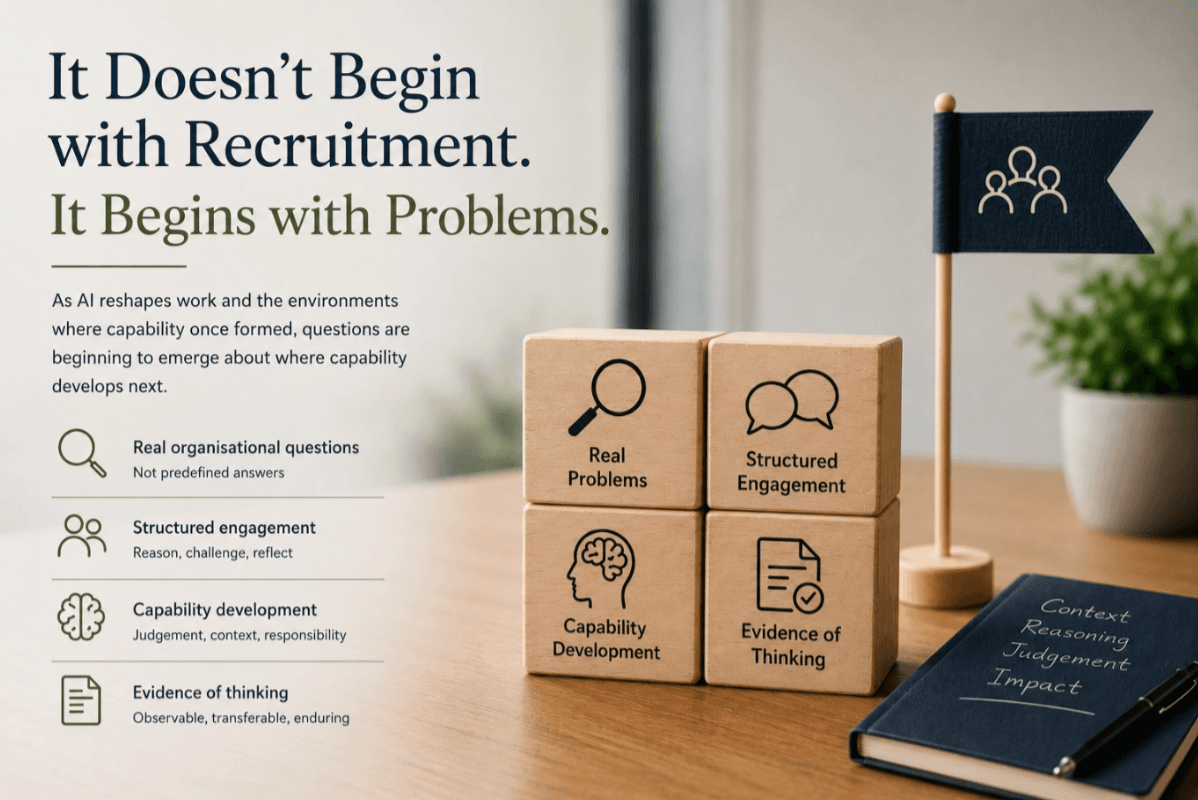
As AI reshapes the environments in which early-stage capability has historically formed, a quieter question is beginning to surface: where does that capability now develop, and who is responsible for the conditions that produce it?
Part of the answer may lie with organisations themselves.
The traditional assumption
For most of modern professional history, the transition from education to meaningful contribution was managed implicitly.
Early-career roles provided more than employment. They offered structured exposure to real problems, real constraints, and gradually increasing responsibility. Capability developed not through instruction alone, but through participation — in contexts where judgement was required, consequences were real, and correction was available.
As AI begins to alter many of the routine functions that underpinned those roles, the developmental environments they provided are also changing. The question is not only how organisations adapt their workflows, but whether the conditions that once formed capability are being deliberately maintained — or quietly lost.
A different kind of employer involvement
There is a version of employer involvement in education that is familiar: sponsorship, mentoring programmes, careers events, graduate recruitment pipelines. These serve real purposes. But they tend to sit at the edges of the capability formation question rather than engaging with it directly.
A different kind of involvement starts earlier and operates differently.
“It does not begin with recruitment. It begins with problems.”
The economist and cognitive scientist Herbert Simon observed that problems are not given — they are perceived. The capacity to recognise what the problem actually is — before attempting to solve it — is itself a form of expertise. It is also one of the capacities most difficult to develop without exposure to real, unresolved situations.
In life sciences and related fields, organisations are continuously engaging with challenges that are not yet resolved — how to interpret emerging research, how to integrate new tools into regulated environments, how to exercise judgement where evidence is incomplete or contested. These are not proprietary secrets. They are the ordinary texture of organisational life in a period of significant change.
Even bounded, light-touch exposure to that texture can begin to recreate some of the conditions under which capability develops: encountering real ambiguity, reasoning through problems without predetermined answers, articulating a position and receiving challenge.
None of this requires significant organisational investment. It requires a genuine question and a structured environment in which to engage with it.
What mutual value might look like
The framing that tends to undermine this kind of engagement is one of extraction: organisations provide access, learners provide outputs, both parties leave with something transactional.
A more productive framing treats the relationship as genuinely reciprocal.
Organisations contribute context, real-world relevance, and problems that matter. Learning environments contribute structured reasoning, reflection, and the translation of capability into observable evidence. Neither replaces the other. Both are necessary.
The organisations best placed to contribute are not necessarily the largest or most prominent. They are the ones facing genuine challenges, open to exploratory engagement, and comfortable with environments where learners are not expected to deliver solutions — but are expected to think seriously about problems.
Readiness matters more than scale or prestige.
A shared responsibility, differently understood
If the pathway from early-stage capability to meaningful contribution is becoming less defined by default, then the responsibility for maintaining that pathway may need to be more deliberately shared.
This does not require large-scale structural reform or formal institutional partnerships. It may begin with something more modest: organisations willing to share a real question, and environments designed to engage with it seriously.
That combination — real problems, structured reasoning, evidence of thinking — may be one of the more practical ways to begin reconnecting capability formation with the contexts in which contribution eventually happens.
If these questions are relevant to your organisation or institution, we’d welcome the conversation. Explore our thinking on human capability at cognateuk.com or connect with us on LinkedIn.
This article reflects the current working perspectives of CognateUK and is intended to support informed discussion. It does not constitute advice or represent the official positions of any affiliated organisations or partners.