
Beyond Exchange: The King John School Design for Life STEM Challenge
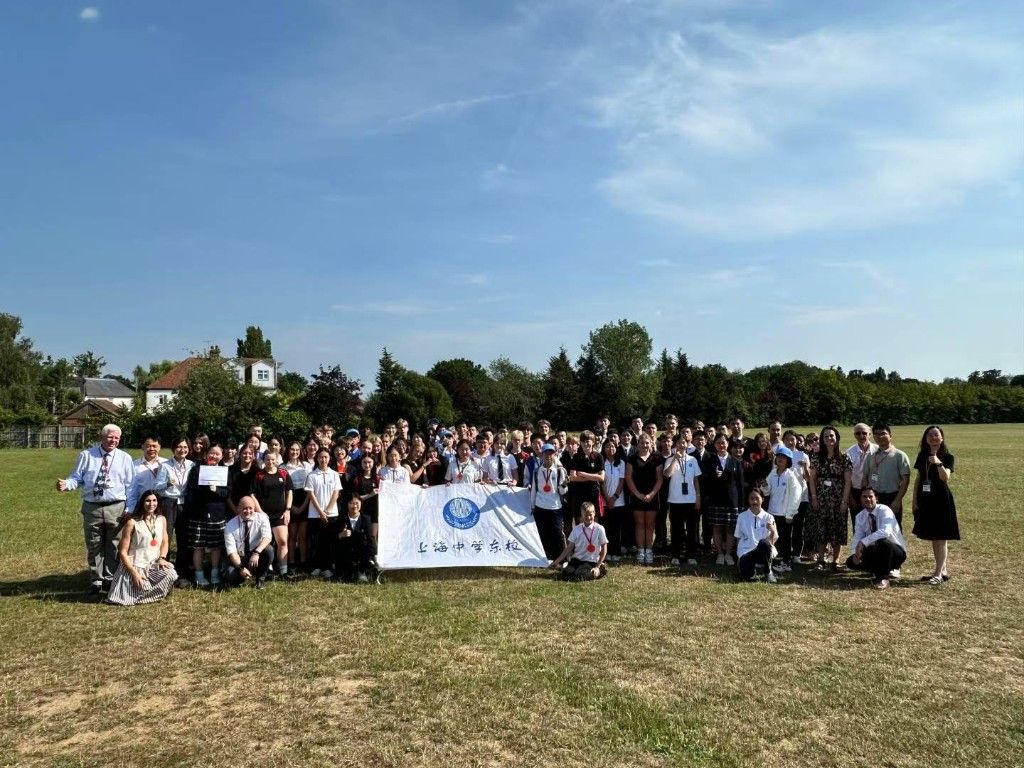
Over two days at The King John School, students from Essex and Shanghai worked side by side to design practical solutions for older adults facing everyday challenges, not against one another, but with the people those solutions were for.
Introduction
Over two days at The King John School, classrooms, workshops and design studios became something rather different. Students from The King John School and East Shanghai High School worked side by side in mixed teams, discussing ideas, sketching concepts, building prototype models and testing solutions to a shared human challenge.
They were not competing against one another.
They were learning together.
The Design for Life STEM Challenge was co-developed by CognateUK and The King John School's Design and Technology Department. CognateUK developed the overall educational concept, the five human-centred design contexts and the empathy boxes. Building on that foundation, the Design and Technology Department transformed the concept into a practical two-day learning experience, introducing the focus-group session with local care-home residents as a key part of the programme.
Starting with People
Many STEM activities begin with technology. This one began with people. Teams first explored real-life design contexts centred on challenges older people may experience in everyday life. After an initial brainstorming stage, students worked through empathy boxes before developing and refining ideas.
Each team developed its ideas differently. Some worked around a lead sketcher, while others divided into pairs before presenting alternative concepts back to the group and combining the strongest elements into a shared design.
Students then chose the making methods most appropriate to their concepts. Some used CAD and laser cutting, others experimented with 3D printing, while many combined digital techniques with traditional model making and workshop practice. The emphasis was on selecting the right process for the design challenge rather than following a single route.
By the end of the first day, ideas had begun to evolve into physical prototype models.
Learning Through Making
The practical structure of the programme reflected the expertise of The King John School's Design and Technology Department. Materials were prepared in advance, workshops organised, and mixed teams supported as they progressed from ideas to prototypes.
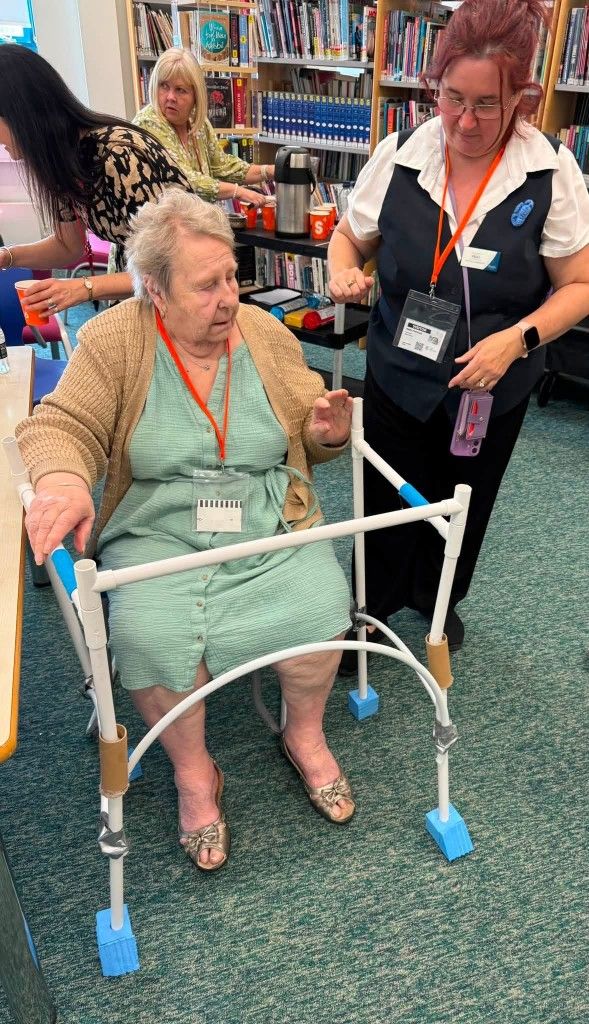
On the morning of Day 2, the department introduced one of the programme's most distinctive features: a focus group involving residents from Grace Court - Sanders Senior Living, supported by Kelly McKenzie from Kinder Essex. Residents were accompanied by care staff, who were also able to explain the practical challenges the residents experience in everyday life, adding further insight to the discussions. Rather than viewing finished work, residents interacted with the prototypes, discussed their experiences and offered feedback before the final presentations, giving students an opportunity to refine their designs in response to authentic user perspectives.
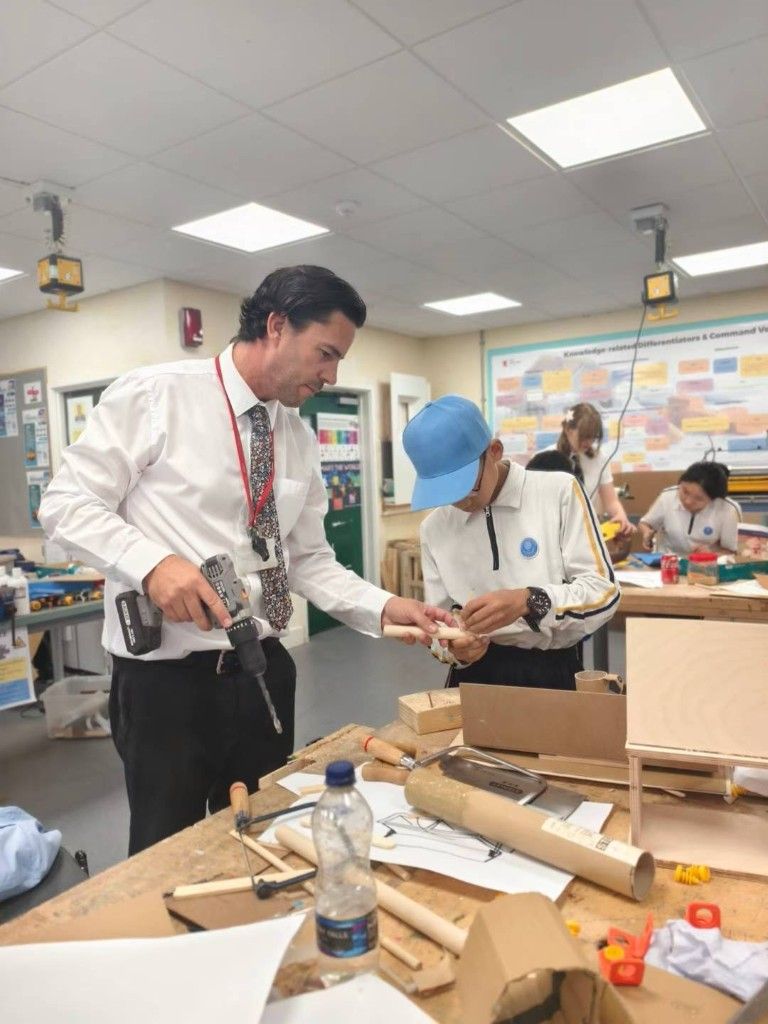
Following the focus group, prototype development continued as teams returned to their designs, refining their prototypes in response to the feedback they had received while also preparing for the final presentations. Students listened carefully, questioned their own assumptions and reconsidered their ideas. One team developing a standing aid spent time rethinking aspects of its design after discussions with residents and carers. The prototype became part of a conversation rather than simply an object for display.
Alongside the design teams, The King John School also created a student media team comprising four students from The King John School and four from East Shanghai High School. Working as a student newsroom, they interviewed participants, photographed the workshops and produced newsletters at the end of each day, which they presented to the wider group. Their work documented the programme as it unfolded while providing students with an authentic role through which they could develop communication, collaboration and reporting skills.
Learning Across Cultures
Teachers observed different approaches to problem-solving. Many students from The King John School explored ideas through experimentation and iteration, while teachers from East Shanghai High School observed that many of their students initially favoured careful analysis before committing to a solution. As the challenge progressed, these approaches became complementary. Teams combined experimentation with careful reasoning, producing stronger outcomes together than either approach alone. In practice, differences in educational background became a source of learning rather than a barrier to collaboration.
Teachers from East Shanghai High School also reflected that, for many of their students, this was their first experience of this kind of human-centred collaborative design challenge. They were struck by how quickly students adapted, worked confidently with their UK peers and embraced new ways of exploring ideas.
Community Perspectives
Michelle Mead, Head of Design and Technology, reflected that watching students test their ideas with the people they were designing for, and then rethink their work in response, was the moment the challenge truly came alive.
Mr Zhang Xiaodong, Group Leader from East Shanghai High School, noted that designing for older people helped students develop teamwork, problem-solving, empathy and social responsibility while addressing a challenge shared by both countries.
Kinder Essex observed that the focus group enabled students to act on authentic user feedback before the final presentations, while Grace Court - Sanders Senior Living commented on the care and thought students invested in designing products to make everyday life easier for older people.
Headteacher's Perspective
Dan Steel, Headteacher of The King John School, reflected that the challenge embodied the school's educational philosophy and provided an opportunity for students to put its PRIDE values, Positivity, Resilience, Integrity, Dignity and Equality, into practice.
"What made this challenge particularly distinctive was its focus on people. Our students were not asked to design for a hypothetical client or solve an abstract engineering problem. They worked with older members of our local community, listened to their experiences and refined their ideas in response to genuine feedback. That process of empathy, creativity and iteration reflects the very best of design thinking.
"Equally important was the opportunity for our students to work alongside their peers from East Shanghai High School. They discovered that different perspectives and approaches to problem-solving are strengths rather than barriers. By learning together across cultures, they developed not only technical understanding but also communication, adaptability and mutual respect, qualities that will serve them well throughout their lives."
Beyond Exchange
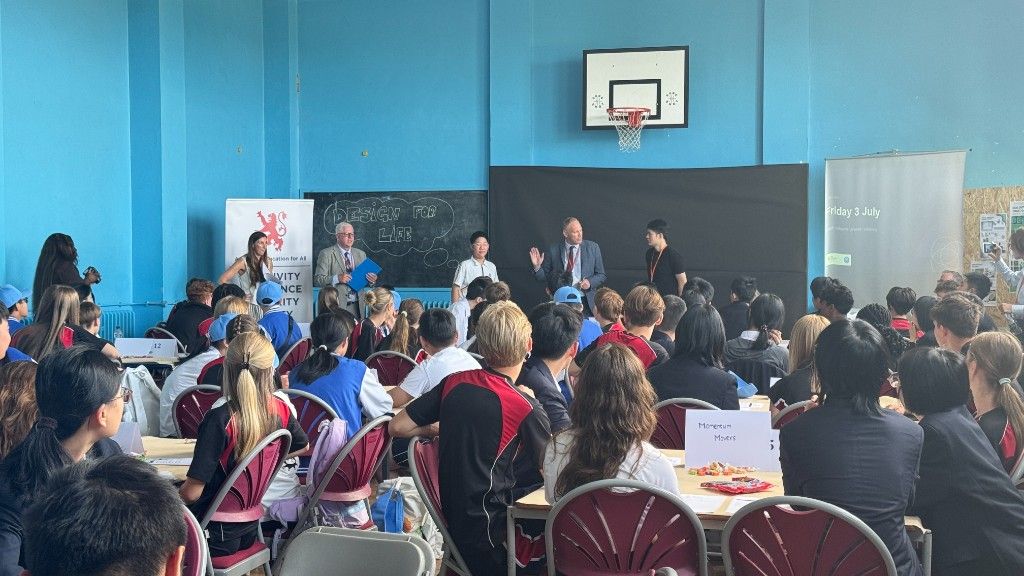
The Design for Life STEM Challenge shows how international partnerships can become much more than exchange visits. The King John School contributed its expertise in practical STEM education and project delivery. East Shanghai High School brought complementary ways of thinking and learning. CognateUK provided the educational architecture, while Kinder Essex and Grace Court helped ensure that students received authentic user feedback from the people they were designing for.
By the end of two days, students who had met only 48 hours earlier were presenting not only what they had designed, but how their thinking had evolved through discussion, feedback and collaboration.
Perhaps that is what moving beyond exchange really means, not simply bringing young people together across borders, but creating the conditions in which they learn to listen, think, make and improve together. In doing so, international partnerships become not only opportunities for cultural exchange, but opportunities for deeper learning.
CognateUK designs human-centred STEM learning experiences in partnership with schools, employers and community organisations in the UK and internationally. This article documents a live programme delivered with The King John School and East Shanghai High School, and reflects the accounts shared by participating staff, students and community partners.