
Case Study
Educational Case Study 001
Design for Life
Designing a human-centred international STEM learning experience
CognateUK · The King John School and East Shanghai High School · 2-3 July 2026 · 7 minutes
Published 21 September 2026
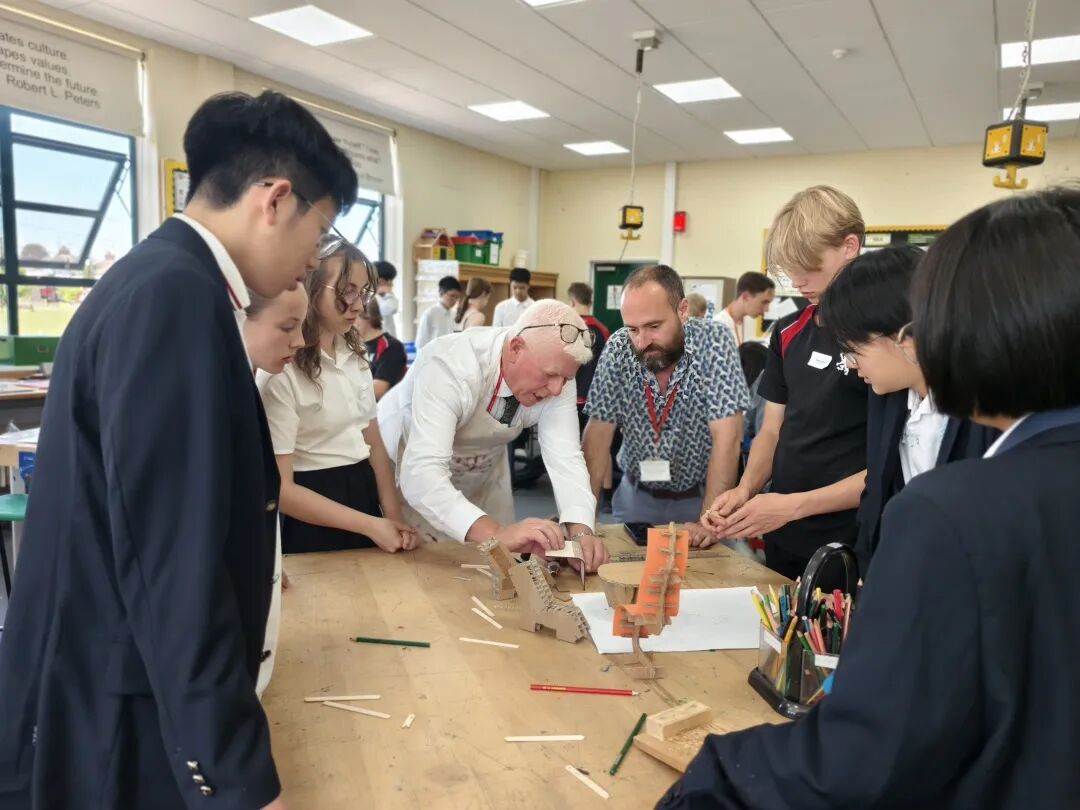
Mixed UK-China teams were asked to design practical responses to everyday challenges faced by older adults. The task was not simply to produce a prototype, but to understand a user, develop and test an idea, respond to feedback, and explain the reasoning behind the final design.
Overview
On Thursday 2 and Friday 3 July 2026, The King John School hosted the first Design for Life STEM Challenge, bringing together students from The King John School and East Shanghai High School for a two-day programme centred on human-centred design.
Mixed UK-China teams were asked to design practical responses to everyday challenges experienced by older adults. The task was not simply to produce a prototype. Students had to understand a user, develop and test an idea, respond to feedback and explain the reasoning behind their final design.
The programme was co-developed by CognateUK and The King John School's Design and Technology Department. CognateUK developed the educational concept, overall brief, five human-centred design contexts and empathy boxes. The school department turned that framework into a working two-day programme by resourcing the activity, preparing materials, running the workshops and CAD/CAM provision, structuring the teams and introducing a resident focus group supported by Kinder Essex.
The result was a single learning experience in which technical design, international collaboration and community participation were deliberately connected rather than treated as separate activities.
The educational challenge
Many STEM activities begin with a technical problem. Design for Life began with a person.
How can young people use design and engineering to improve another person's everyday life?
Students were encouraged to understand users before settling on solutions. Brainstorming came first, followed by empathy-box activities that prompted teams to revisit assumptions and generate further ideas. The intention was to make designing, making, listening and revising part of the same process.
Partner model
The programme depended on different partners contributing distinct forms of expertise and participation.
| Partner | Contribution |
|---|---|
| CognateUK | Educational concept, overall brief, five human-centred design contexts, empathy boxes and programme architecture. |
| The King John School | Practical resourcing and delivery, including materials, workshops, CAD/CAM provision, team and room structure, and the resident focus group. |
| East Shanghai High School | Students and teachers participating in mixed international teams and the wider two-day learning experience. |
| Kinder Essex | Community partnership support for the resident focus group. |
| Grace Court - Sanders Senior Living | Residents and care-home staff contributing authentic user feedback during the design process. |
Learning journey
The programme followed a deliberately structured sequence, while leaving teams room to choose how they developed and made their ideas.
Day One | Thursday 2 July
Students were introduced to five design contexts based on challenges older adults may experience in everyday life. After an initial brainstorming stage, teams used empathy boxes to explore the person behind the problem and generate a further wave of ideas.
Teams did not all work in the same way. Some used a lead sketcher; others split into pairs, developed separate ideas and then combined or selected the strongest elements.
In the afternoon, teams moved into the workshops. Some used 2D Design software to produce laser-cut files, several used 3D printing for elements or iterations, and others chose traditional model-making and basic workshop machinery. The activity therefore supported multiple routes from idea to prototype rather than prescribing a single technical method.
Alongside the design teams, eight students, four from each school, formed a joint student media team. They worked as a student newsroom, producing a first newsletter at the end of Day One and reading it to the wider group.
Day Two | Friday 3 July
Three residents from Grace Court - Sanders Senior Living joined the programme as a focus group, accompanied by a member of care-home staff and supported by Kinder Essex. Teams presented their concepts and prototype models, listened to practical feedback and returned to their work with new information.
The afternoon was divided between prototype refinement and presentation preparation. This protected time for teams to respond to feedback while also preparing to explain their final design and the reasoning behind it.
One team developing a standing aid reconsidered aspects of its design after speaking with residents and carers. Another designed an automatic lifting device to help older people reach items on high shelves, using a syringe and foot-pedal mechanism and a moveable storage compartment. In his post-event reflection, Mr Zhang Xiaodong from East Shanghai High School singled out this project as particularly memorable, noting both the practical application of knowledge and the care shown towards older users.
The student media team interviewed participants, photographed the workshops and produced a second newsletter, which they presented after the final team presentations. The programme closed with judging, awards, a group photograph and closing remarks.
What we learned from delivery
Authentic users changed the work. The resident focus group did more than observe finished products. Because feedback came while designs were still live, students had to reconsider assumptions and decide what to change.
Iteration needed protected time. Feedback only became educationally useful because teams had time afterwards to refine prototypes. The sequence of feedback, reconsideration and revision was therefore as important as the final presentation.
Different making routes were a strength. Digital tools were useful, but they were not the only route to a solution. Laser cutting, 3D printing, traditional model making and workshop machinery sat alongside one another, allowing teams to choose methods that suited their designs.
International collaboration was part of the task. Mixed teams had to communicate ideas, negotiate choices and make decisions with peers from another school and educational culture. Collaboration was therefore embedded in the work rather than added as a separate activity.
Different approaches could become complementary. In his post-event reflection, Mr Zhang observed that, within these particular groups, British students tended to explore through openness and trial and error, while Chinese students tended to research thoroughly and reason carefully before settling on a solution. The value was not in treating one approach as better, but in seeing different habits of thinking brought into the same collaborative task.
Authentic projects can support different roles. The student media team created a second route into the programme through interviewing, photography, reporting and presentation. Not every meaningful contribution needed to sit inside the prototype teams.
Perspectives from the partnership
The King John School
"What made this challenge particularly distinctive was its focus on people. Our students were not asked to design for a hypothetical client or solve an abstract engineering problem. They worked with older members of our local community, listened to their experiences and refined their ideas in response to genuine feedback. That process of empathy, creativity and iteration reflects the very best of design thinking."
Dan Steel, Headteacher, The King John School
"The starting point genuinely came from CognateUK. The overall brief, the five design contexts and the idea of empathy boxes were theirs, and gave us a wonderful foundation. Where our department added most was in resourcing and delivering it in practice, and the one element we introduced ourselves was the focus group with residents from a local care home. So co-developed feels exactly right."
Michelle Mead, Head of Design and Technology, The King John School
East Shanghai High School
"Many of the Chinese students were experiencing this type of programme for the first time. The extent to which they integrated with the group, supported by their British peers, exceeded my expectations."
Mr Zhang Xiaodong, Group Leader, East Shanghai High School (translated from Mandarin)
In a follow-up reflection, Mr Zhang also identified open and divergent thinking, real-life problem-solving, presenting STEM work, collaborative enquiry and cross-disciplinary learning as aspects the Shanghai students experienced through the two-day programme.
Community partners
Kinder Essex supported the focus-group element, while residents and staff from Grace Court - Sanders Senior Living contributed practical user feedback before final presentations. Their involvement moved the community contribution from observation into the design process itself.
Transferable practice
The following design principles emerged from the programme and partner feedback:
- begin with an authentic human need rather than technology alone;
- use empathy activities to deepen the initial problem definition;
- allow teams more than one route through design and making;
- involve authentic users while there is still time to change the work;
- protect time for revision after feedback;
- create meaningful roles beyond the core design team where appropriate;
- ask students to explain how their thinking changed, not only what they produced.
What this informs
Design for Life gave CognateUK and its partners a practical example of how technical learning, community participation and international collaboration can be brought together inside one project. The most useful learning was not a single prototype or presentation, but the sequence that surrounded the work: understand the person, develop an idea, make it visible, listen to feedback, revise and explain the judgement behind the final decision.
Those observations can now inform future programme design, particularly where CognateUK wants students to produce evidence of how their thinking develops through authentic work rather than simply present a finished outcome.
About this case study
This case study draws on programme documentation, delivery materials, observations during the two-day challenge and post-event reflections from participating school and community partners, including reflections provided in Mandarin by East Shanghai High School and translated for publication. It is intended to document educational practice, partner contribution and organisational learning for future programme development.
Acknowledgements
CognateUK gratefully acknowledges The King John School, East Shanghai High School, Grace Court - Sanders Senior Living, Kinder Essex, and the staff, students and community members who contributed to the programme and its review.
Appendix
A. Programme sequence
Day One | Thursday 2 July: welcome and orientation; cross-cultural conversation; project briefing; initial brainstorming; empathy-box work; concept development; prototype making using a mix of digital and traditional methods; Day One media-team newsletter.
Day Two | Friday 3 July: teams re-formed and continued their work; Grace Court focus group; prototype refinement; presentation preparation; final team presentations; media-team showcase; judging, awards and closing remarks.
B. Five design contexts
| Challenge | Human need | Profile |
|---|---|---|
| Steady Steps | Mobility and balance | Margaret |
| Easy Reach | Arm and shoulder | David |
| Open Sesame | Grip and dexterity | Li Wei |
| Keep in Touch | Connection and dignity | John |
| Get Up & Go | Legs and joints | Zhang Hua |
C. Student media team
Team: eight students, four from The King John School and four from East Shanghai High School, working as a joint student newsroom.
Day One: produced a first newsletter and read it to the wider group.
Day Two: interviewed participants, photographed the workshops and produced a second newsletter, presented after the final team presentations.
Purpose: to create an authentic communication and reporting role alongside the design teams.
D. Judging criteria
Five areas were scored out of 20, giving a total of 100 points:
- Empathy and understanding
- Creativity and innovation
- Practicality and feasibility
- Prototype quality
- Teamwork and communication